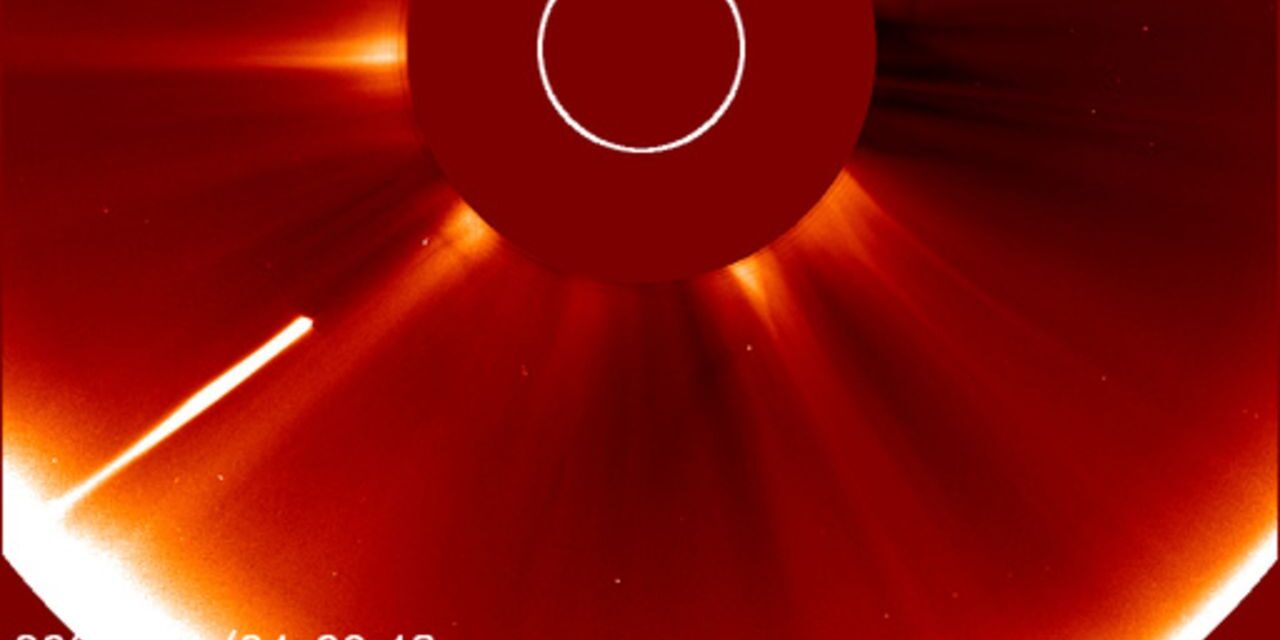
A cosmic spectacle has come to an abrupt end as Comet MAPS, a superbright sungrazer, was recently torn apart after a close encounter with the Sun. Astronomers had tracked the comet’s remarkable journey since its discovery, make its unpredictable demise all the more poignant for both scientists and space enthusiasts alike. Now, what was once a promising astronomical phenomenon is becoming a “headless wonder,” as its core pieces disintegrate, leaving little but a cloud of dust and shrapnel behind.
What happened
Comet MAPS, officially designated as C/2023 P1, burst onto the scene earlier this year, captivating stargazers with its dazzling tail and luminance as it approached the inner solar system. The comet was on a trajectory that brought it alarmingly close to the Sun, an event eagerly anticipated by astronomers who hoped to study the comet’s composition and behavior during such extreme conditions. However, as it neared perihelion—its closest approach to the Sun—intense gravitational and thermal forces proved overwhelming. Recent observations confirmed that the comet fragmented into at least a dozen visible pieces, leaving scientists scrambling for answers about its characteristics and what led to its violent decomposition.
Why it matters
The disintegration of Comet MAPS is significant for several reasons. Firstly, sungrazing comets like MAPS provide astronomers a rare opportunity to study the early solar system’s building blocks. By analyzing what remains of the comet, researchers can gain insights into the primordial materials that coalesced to form planets. Additionally, this event underlines the inherent dangers comets face when passing near the Sun, a phenomenon that can shed light on the lifespan of such celestial bodies. The study of similar sungrazers could also improve our understanding of other space objects, particularly those on potentially hazardous trajectories toward Earth. Finally, this disassembly marks a loss within the astronomical community, where each discovery is cherished, and every observation is a potential key to unlocking cosmic secrets.
What comes next
In the wake of Comet MAPS’ fragmentation, astronomers are now keen to observe the remnants left behind. The debris trail will offer a wealth of information, allowing for analyses of the comet’s original materials and its behavior in intense solar environments. Future observations, aided by telescopes equipped with advanced imaging, will be focused on tracking the residual particles and their trajectories. Scientists are also monitoring similar comets that may come close to the Sun in the near future, hoping to predict and perhaps prevent scenarios like that faced by MAPS. The ongoing studies will likely lead to new discoveries about the lifecycle of comets and enhance our understanding of our solar system’s dynamic environment.
As researchers turn their telescopes toward the remnants of MAPS, the broader implications surrounding its demise will surely ripple through the field of astronomy, paving the way for deeper explorations beyond our world.
Original Source: https://www.livescience.com/space/comets/rip-comet-maps-watch-the-superbright-sungrazer-become-a-headless-wonder-after-being-ripped-apart-by-the-sun