
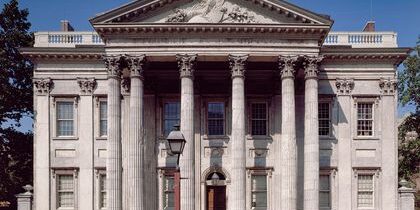
After years of closure, the First National Bank of the United States, a cornerstone of early American finance, has reopened its doors in Philadelphia as a dedicated museum. Originally established in 1791 under the guidance of Founding Father Alexander Hamilton, the bank played a critical role in shaping the nascent economy of the United States, serving as a model for modern banking systems.
Key details
The First National Bank, situated at the corner of Third and Chestnut Streets, was the United States’ first attempt at establishing a government-backed financial institution. Designed by the architect Samuel Blodget, the building is an embodiment of neoclassical style. After its initial operations, which ran until its charter expired in 1811, the structure had various uses, but it fell into disrepair until recent renovations transformed it into a museum dedicated to its historical significance.
The museum now features interactive exhibits detailing Hamilton’s vision for a unified financial system and the role of the bank in fostering credit, managing public debt, and stabilizing the national currency. Visitors can explore artifacts, documents, and digital displays that illuminate the pivotal moments in economic history that the bank influenced.
Why this matters
The reopening of the First National Bank as a museum is notable not only for its architectural restoration but also for its educational potential. In an era where discussions about the economy are ubiquitous, understanding the foundations of the American financial system is crucial. Hamilton’s principles of fiscal responsibility, the significance of a central bank, and the establishment of a national credit were groundbreaking concepts at the time and remain influential today.
This renewed focus on Hamilton’s contributions aligns with growing public interest in historical narratives that shape current societal structures. The bank’s reopening serves as a reminder of the complex relationship between government and finance, as well as the potential for such institutions to foster economic growth. Educational programs and tours promise to engage citizens in discussions about fiscal policy, economic history, and the legacy of the Founding Fathers.
Broader picture
The First National Bank’s transition into a museum reflects a broader trend of reconsidering historical financial institutions as pivotal in understanding contemporary economic challenges. As America navigates the complexities of debt, inflation, and the policies of modern banking systems, revisiting the origins of its financial framework provides valuable lessons. The narrative of Hamilton’s bank illustrates the balance of innovation and regulation, as well as the constant evolution of economic infrastructures.
In a political landscape marked by fiscal debates, the museum fosters a dialogue on the importance of financial literacy and historical perspective. As the First National Bank reopens, it not only pays homage to its past but also invites future generations to glean insights from the economic strategies that forged the United States. The reopening stands as an opportunity to understand and appreciate the intricate roots of American finance that are foundational to its economic narrative today.