
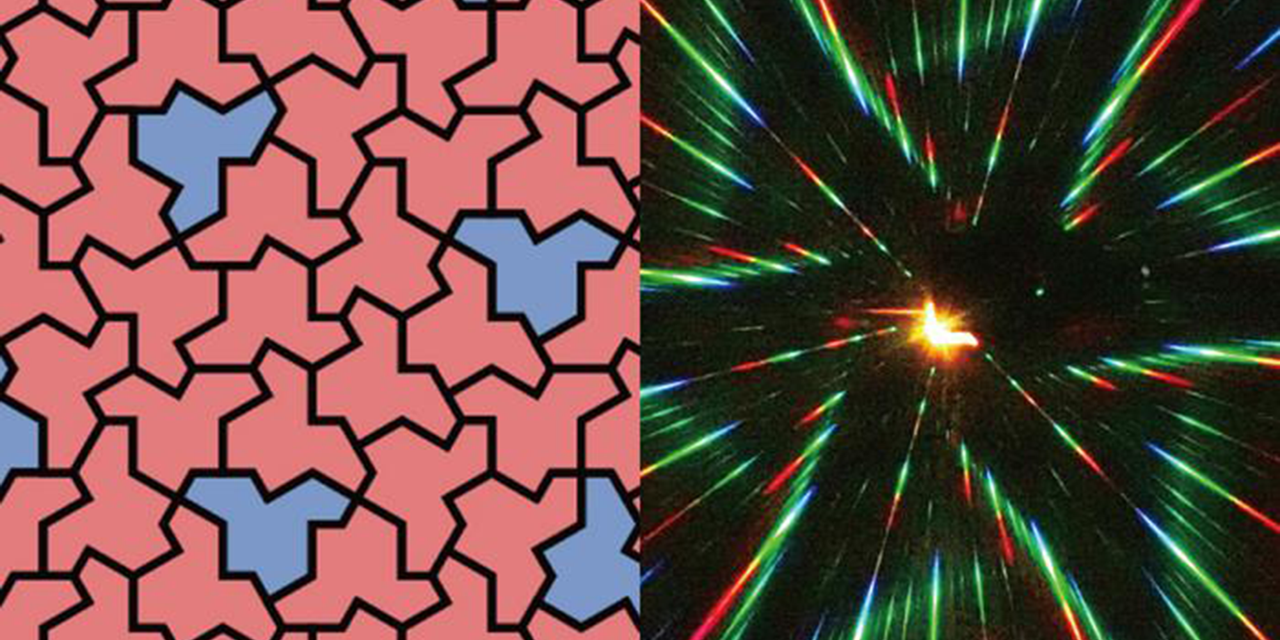
A groundbreaking advancement in optics has emerged as researchers have successfully created a crystal based on a rare geometric shape known as the 13-sided “Einstein” structure. This innovative crystal has demonstrated an unprecedented ability to manipulate light in ways that defy conventional understandings, leading scientists to rethink the potential applications and implications of light manipulation in various fields.
What happened
The team, consisting of physicists and material scientists, reported their findings in a recent publication in the journal ‘Nature Physics.’ Their work centers around the design of a crystal formed from a complex arrangement of atoms, structured to mimic a polyhedron with thirteen faces. The significance of this unique configuration lies in its ability to create a distinct optical effect, bending and twisting light in non-intuitive ways.
This phenomenon occurs due to the specific arrangement of the crystal’s atomic lattice, which induces peculiar light paths as photons pass through it. Unlike traditional materials, this Einstein crystal allows for the manipulation of light at various wavelengths, promising innovative uses in telecommunications and photonic circuits.
Why it matters
The implications of this discovery are vast. By bending light differently, the 13-sided crystal opens new avenues for optical devices that could drastically improve the efficiency of data transmission. This is particularly relevant as the demand for faster and more efficient data communication increases with advancements in technology.
Moreover, the ability to manipulate light in novel ways could lead to breakthroughs in imaging systems, potentially enhancing everything from medical diagnostics to cameras. The fine control over light patterns may also have applications in creating new types of quantum computing components, thereby impacting the future of computing technology as well.
What comes next
The immediate focus for researchers is to explore the full range of optical properties this crystal can exhibit. Ongoing experiments aim to understand the limits of its light-bending capabilities and how they can be harnessed in practical applications. The team is also collaborating with engineers and technologists to conceptualize devices that utilize these unique properties.
As the research progresses, the scientific community is watching closely. The next critical milestone will be to develop prototypes that incorporate the crystal into working systems, which could potentially lead to transformative developments in optics and photonics.
This groundbreaking work lays the foundation for a new era in materials science, with the hope that the Einstein crystal may soon revolutionize how we interact with light and expand the boundaries of technological innovation.
Original Source: https://www.livescience.com/physics-mathematics/crystal-made-from-13-sided-einstein-shape-bends-light-in-ways-nobody-imagined