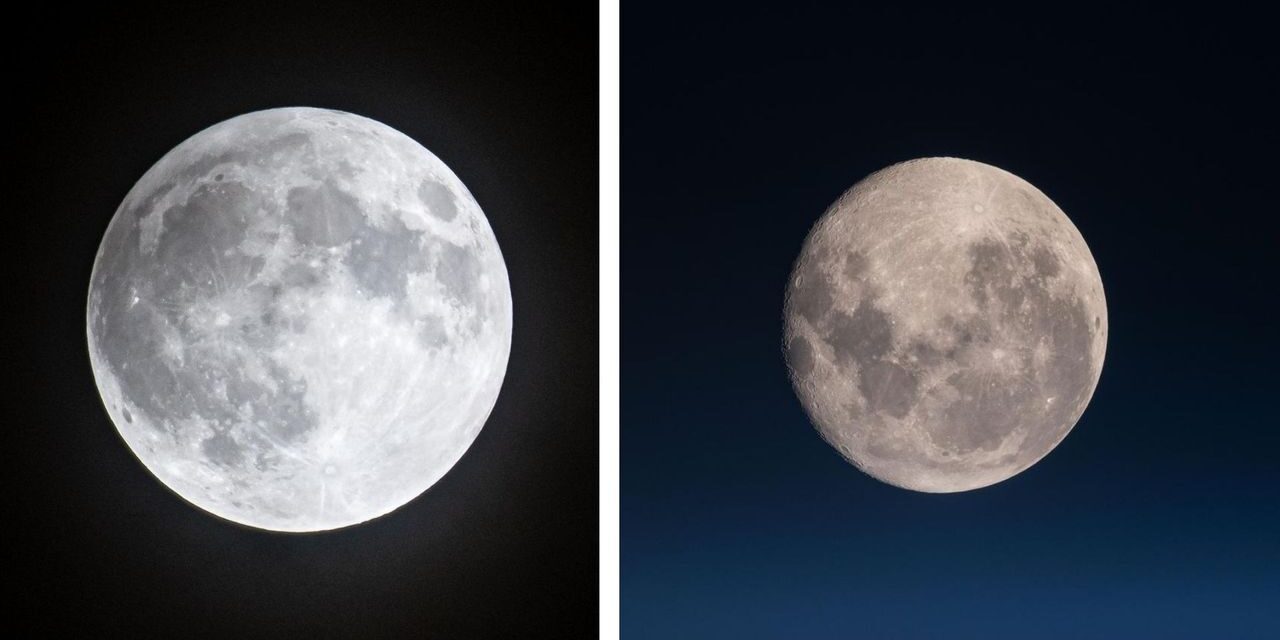
While the moon captivates stargazers across the globe, it does not present the same visage to every observer. Various factors influence its appearance, resulting in unique visual experiences depending on where one stands on the planet.
Background and context
The moon is Earth’s only natural satellite and orbits our planet at an average distance of about 238,855 miles (384,400 kilometers). It takes approximately 27.3 days to complete one orbit, during which it reflects sunlight in phases—from new moon to full moon.
Though the moon appears to change shape over these phases, its actual surface remains constant. However, the visibility of its features, like the Sea of Tranquility or the recognizable dark spots known as maria, varies according to the observer’s geographical location. This phenomenon is primarily due to the tilt of the Earth’s axis and the angle of the moon’s orbit.
To understand why the moon might look different from various points on Earth, it’s essential to discuss the concept of the “far side” of the moon, which cannot be seen from Earth. The moon is tidally locked, a state in which it rotates on its axis in the same duration it takes to orbit Earth. This means that one side, the near side, is always facing us, while the far side remains hidden from direct view.
Latest developments
Recent advancements in lunar observation technology and global interest in space exploration have sparked renewed attention on how the moon is perceived from different locations on Earth. Notably, space agencies and organizations have invested in high-resolution imaging and mapping of the moon’s surface. For instance, NASA’s Lunar Reconnaissance Orbiter has produced detailed maps that allow both amateur astronomers and scientists to compare their local views of the moon against a comprehensive collection of images from its entirety.
This resurgence of interest has not only enhanced scientific understanding but has also fostered a greater public engagement with astronomy. Events such as lunar eclipses and supermoons draw crowds worldwide, where viewers often marvel at the moon’s beauty, oblivious to the varying perspectives that accompany these celestial displays.
What to watch next
As interest in lunar studies continues to grow, it is worth keeping an eye on upcoming celestial events that affect lunar visibility. Notably, the positions of the Earth, moon, and Sun will play crucial roles in phenomena like eclipses, which can temporarily alter the moon’s appearance in specific regions. Furthermore, ongoing exploration missions by NASA and other space agencies are expected to yield new insights into the moon’s surface and its geographic diversity. Virtual astronomy tools and apps are also becoming increasingly sophisticated, allowing users to delve deeper into their personal lunar experiences, regardless of their location on Earth.
As technology advances and global interest in astronomy expands, the moon’s influence will undoubtedly continue to inspire observers, highlighting both its wonders and the intriguing variations in how it is perceived from our diverse planet.
Original Source: https://www.livescience.com/space/the-moon/does-the-moon-look-the-same-from-everywhere-on-earth