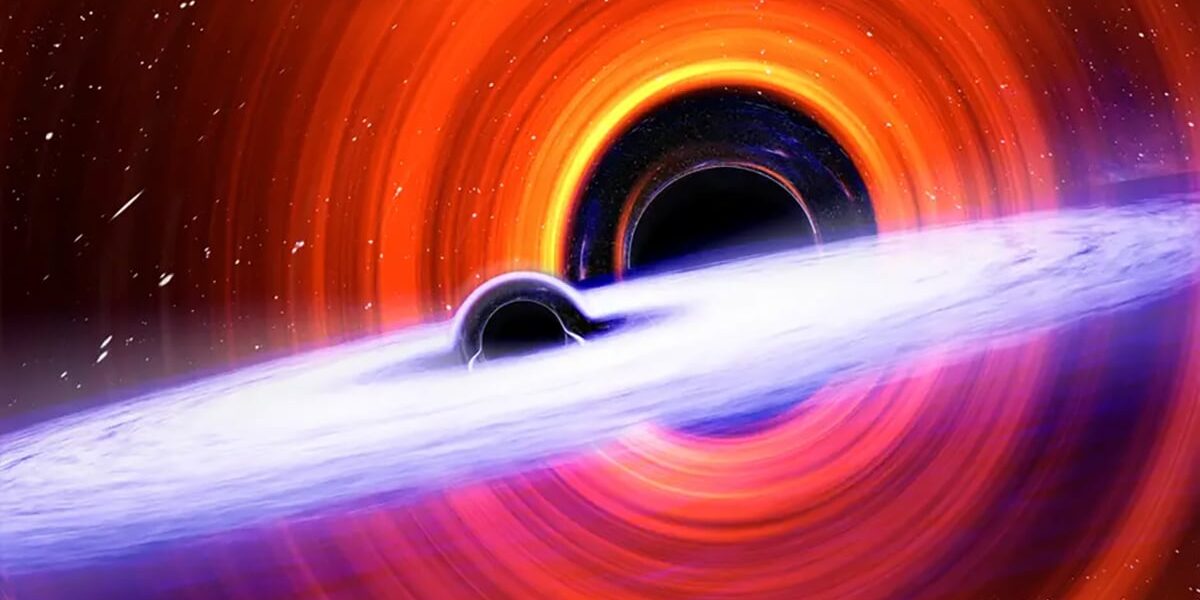
Scientists at the Laser Interferometer Gravitational-Wave Observatory (LIGO) may have made a long-awaited breakthrough – the detection of a primordial black hole. This groundbreaking development surfaced following a recent analysis of the data collected by LIGO, which some researchers believe may contain evidence of a primordial black hole.
Formed not from collapsing stars, but from density fluctuations in the universe’s early moments, primordial black holes represent a significant, yet elusive, element of astronomical research. If the proposed detection is verified, it would mark the first observation of its kind, bringing with it a wealth of new information about the origins of the universe.
Primordial black holes are distinct from their cosmic counterparts. Unlike stellar black holes, which are generated by the collapse of massive stars, primordial black holes originate from the high-pressure environment present in the moments following the Big Bang. Due to the extreme conditions at that time, these entities harbor the potential to significantly vary in mass.
Scientists speculate that many of these primordial black holes could still exist today and could offer an explanation for the existence of dark matter – an enigmatic and invisible substance that accounts for much of the universe’s mass. Despite their likely prevalence, these primordial entities have remained undetected – until now.
Data collected from the LIGO system in 2015 clued the scientists into the existence of a possible, primordial black hole. Specifically, the data pointed to two collisions between gravitational waves – ripples in space-time caused by violent cosmic events. The masses of these colliding entities roughly align with the potential mass of primordial black holes, leading experts to consider seriously the likelihood of the first-ever detection.
Professor Vuk Mandic, a physicist involved in the project, said, “The properties of this black hole… fall within the possible range for primordial black holes” and as such “it could be a primordial entity that contributed to dark matter.” This exploratory suggestion offers a promising opening for further research and investigation.
It is important to note that while these preliminarily findings are exciting, they are not yet definitive. The gathered data only suggests that the black holes involved could be primordial, and other explanations for their nature exist. Additional rigorous investigation is required for confirmation. Nevertheless, the likelihood suggested by the data is enough to excite the scientific community.
This comes as a revolutionary leap for theoretical physics and cosmology, a field that has until now been starved of tangible evidence to support the existence of primordial black holes. The proposal is already sparking debates and furthering scientific enquiry on a global scale.
Scientists all across the globe are now ramping up their efforts, utilizing high-tech detectors and sensitive space probes, to decode these signals from the distant past. These efforts could eventually bring answers to some of the most puzzling questions about our universe, its origins, and its composition.
The potential detection has received widespread attention on the internet, with science communities and forums debating its implications. The potential for astronomical exploration and discovery is tremendous, signaling a new era in our understanding of the universe.
As we seek confirmation and more details regarding this potential discovery, one thing is clear – we stand at the brink of a new chapter in astronomical science. Affirmation of the existence of primordial black holes could trigger a shake-up in theoretical physics and cosmology, providing clues to the enigmatic dark matter that pervades our universe.
In the words of Prof. Mandic, “It’s a tantalizing prospect for the physics community. But we must remember that we are not yet sure of what we’ve detected at this point.”
While these initial forays into the dark universe bring excitement, they remind us of our relative infancy in exploring the cosmic frontier. Irrespective of the conclusion, the journey promises to propel our understanding about the universe into new territories and dawn a new era in cosmology.
Original Source: https://www.sciencealert.com/ligo-may-have-detected-the-first-primordial-black-hole-scientists-say