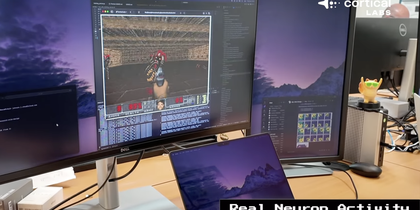
In what seems like an extraordinary mash-up of science fiction and reality, a clump of human brain cells, grown on a computer chip, has learned to play the classic video game ‘Doom.’ This groundbreaking discovery has been making surges within the scientific community due to its implications for future innovations in Artificial General Intelligence (AGI).
Researchers from the Salk Institute for Biological Studies in San Diego, California developed these “mini-brains,” clumps of human brain cells known as organoids, and integrated them with a special silicon chip. The organoids are not capable of forming thoughts or consciousness but mimic many of the interactions and reactions found in a full-scale human brain.
Marking a significant leap forward, the team exhibited progress when these organoids learned to control a digital avatar within the game ‘Doom,’ a feat achieved using the mechanics of reinforcement learning. This signifies the potential for advancements in fields such as computing, neuroscience, and psychology.
Growing the mini-brains from human stem cells, the scientific team cultivated them for months until they developed neurons and started firing electrical signals. These lab-grown brain organoids were then integrated with a light-sensitive chip which allowed the researchers to control and observe their activities.
The real breakthrough came when the research team employed the organoids to play ‘Doom’, a cult classic game from the 1990s. By applying light pulses, the researchers manipulated the organoids to respond to their actions within the game. Through reinforcement learning, a type of machine learning where behavior is driven by rewards or punishment, the organoids amazingly took control of the avatar in the game.
The project’s lead scientist, Dr. Fred Gage, stated, “This is a paradigm shift for thinking about how we could use human organoids for studying things we’ve been totally reliant on experimental animals for.”
Although the organoids demonstrated machine learning capability, they still lack other factors to form a fully functioning human brain. They can’t feel emotions or form memories, presenting an ethical grey area that sidesteps potential exploitation concerns often linked with studies of this nature. The novelty of this experimental method also opens a transformative path in the study of mental disorders, drug testing, and advanced AGI development.
The reaction to this news has been a blend of fascination and skepticism. Dr. Nita Farahany, a bioethicist from Duke University, commented, “It’s possible this is opening up a completely new playground of research. But until we have more information about what these organoids can and can’t do, we need to tread carefully.”
Elsewhere in the online community, observers have noted the symbolic significance of ‘Doom’ in this scenario, suggesting it as a metaphor for the possible pitfalls of unchecked AI and bioengineering capabilities. The 1993 game, known for its fast-paced and often chaotic gameplay, might serve as a cautionary tale about the rapid and often unpredictable advancements in technology.
Despite the scepticism, this extraordinary achievement from the Salk Institute demonstrates the intersection of biology and technology, acting as a launchpad for potential advancements. According to Professor Rusty Gage, also a part of Salk Institute, this research could, “advance our understanding about the human brain and brain disorders and open up new ways to study neurological diseases in a laboratory dish”.
As the universe of neuroscience continues to expand, such interdisciplinary engagements offer new ways to understand one of the most complex structures known to mankind. The organoids’ aptitude for learning may sooner or later unlock novel insights into the functioning of the human brain, possibly leading to significant breakthroughs in the field of AI.
Original Source: https://www.smithsonianmag.com/smart-news/a-clump-of-human-brain-cells-on-a-computer-chip-learned-to-play-the-nostalgic-video-game-doom-180988447/