
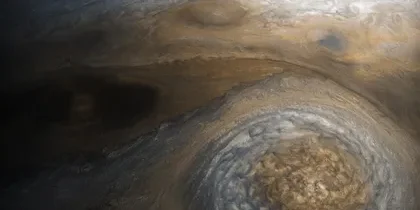
JUPITER – In a stunning development that illuminates the dynamic and complex nature of Jupiter’s weather system, recent research suggests the gas giant’s lightning strikes are approximately 100 times more potent than Earth’s. The study, a potentially ground-breaking piece of planetology, also underlines the inherent unpredictability and pure power exhibited by Jupiter’s immense electrical storms.
The celestial weather, particularly on massive gas giants such as Jupiter, has long been a source of fascination and mystery for astronomers worldwide. This latest study graphically illustrates the extraordinary climatic conditions to be found on our solar system’s largest planet. The research is based on data collected by NASA’s Juno spacecraft, which has been orbiting Jupiter since July 2016.
Lightning discharge on Earth typically measures between 100 million and 1 billion volts, producing around 30,000 amps. On average, they can generate energy varying from a few thousand megajoules to tens of thousands. The research suggests that lightning discharge on Jupiter could exceed 1 billion volts, with an accompanying current above 300,000 amps. This translates to an overwhelming force 100 times greater than lightning on Earth.
The higher energy output of Jupiter’s lightning is believed to be due to the planet’s unique atmospheric composition. While Earth’s atmosphere comprises primarily nitrogen and oxygen, Jupiter’s is overwhelmingly dominated by hydrogen and helium, which are less conductive. This composition results in much more energetic lightning. Moreover, with the lack of a solid surface and the planet’s intense gravity, deep atmospheric pressures can reach 100,000 times that of Earth’s, further fuelling the force of these storms.
Dr. Shannon Brown, a researcher at NASA’s Jet Propulsion Laboratory and the lead author of the study, suggested, “The difference probably lies in how much vapor, ice, and liquid are available in the two planets’ thunderstorms. On Jupiter, there’s a plentiful supply of water to fuel these massive storms and lightning.”
The storms contribute to Jupiter’s reputation as a hotbed of climatic chaos. The planet is famous for its Great Red Spot, a storm system more than twice as large as Earth that has been churning for at least 150 years. Jupiter’s fast rotation also leads to extreme polar cyclones, which dwarf any earthly tornado in both size and intensity.
The shocking findings of the recent study not only reiterate the awe-inspiring power and mystery of Jupiter’s lightning but also reaffirm the role of advanced spacecraft like Juno in aiding our understanding of the solar system’s complexities.
The Juno mission, in exploring Jupiter’s weather system intricacies, will allow scientists to shed additional light on other dynamic weather processes happening throughout the rest of our solar system. As Brown highlights, “Understanding more about lightning on Jupiter enables us to make sense of atmospheric dynamics both on Jovian planets in our solar system and on extrasolar planets being discovered.”
Given the startling power of Jupiter’s lightning strikes, further study will certainly elucidate the captivating, and often dangerous, weather systems of the planets in our cosmic neighbourhood. As Juno continues to gather an increasing wealth of data on Jupiter’s immense storms, it promises to unlock further secrets of this fascinating gas giant. However, even as we deepen our understanding, Jupiter steadfastly remains a symbol of the sublime spectacle that planetary science has to offer.
Original Source: https://www.smithsonianmag.com/smart-news/lightning-strikes-on-jupiter-are-100-times-as-powerful-as-those-on-earth-a-new-study-suggests-180988455/