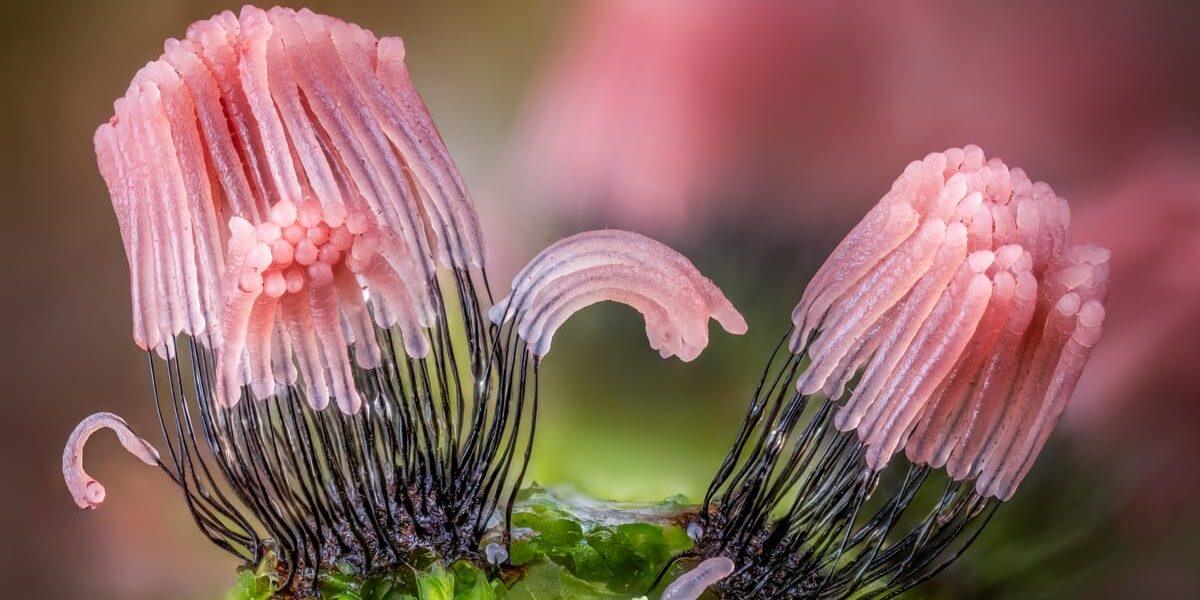
Eminent wildlife photographer Barry Webb has successfully captured a fantastic array of thriving, colorful slime molds in a newly released remarkable sculptural photo series. In an effort to shed light on these often overlooked specimens, Webb’s photos highlight the intricate, bizarre, and striking beauty found within the macroscopic landscape of many a garden and forest floor.
Slime molds are unique organisms found predominantly in the damp, decayed woods and areas with abundant organic material. Though they generally escape our notice due to their size, slime molds come to the forefront in Webb’s impressive portfolio, displaying a spectacular range of colors, formations, and structures.
Webb, an experienced wildlife photographer, spent two years painstakingly photographing a multitude of these complex organisms in their natural habitats, enabling him to unveil a vibrant universe often invisible to the naked eye. Having previously focused on larger forms of wildlife, Webb’s shift to the commonly underrepresented marvels of the micro are a testament to his exhaustive breadth as a photographer. Now, Webb’s macro photos of slime molds are garnering praises from both casual viewers and the scientific community for their symphony of color embedded in biological wonders.
Webb gives credence to the remarkable diverse colors and unique structures of slime molds – shades of radiant yellows, dramatic reds, and deep blues can be found within these minute life forms. Many of his images illustrate the macro details, showcasing enhanced textures and structure that would otherwise go unnoticed. In some instances, the visual fantasy captured under Webb’s lens makes it closer in resemblance to exotic coral reefs or abstract art rather than fact-of-matter amoeboid protozoa.
Beyond just the aesthetic appeal, his winning photographic series serves a secondary, equally important purpose. Slime molds are decomposers, vital to the ecosystem for breaking down dead organic matter and bringing nutrients back into the soil. Knowledge about these organisms can contribute to better understanding of the nutrient cycle in the environment, an aspect that has myriad repercussions for conservation of the natural world.
In a statement on his website, Webb stated, “My hope with this ongoing project is to show the public that beauty can be found in the most unexpected of places and that the mundane and everyday can harbour exciting and unexpected surprises.”
Despite being a common occurrence around forest floors worldwide, slime molds are largely under-studied. They hold a plethora of potentials in varied fields from computing to bioengineering, design, gastronomy, and pharmacology, aside from the already known benefits to the soil. Webb’s extraordinary collection, in its own artistic realm, is encouraging a much-needed dialogue about the ecological and scientific relevance of these unique organisms, bringing them the attention they deserve.
The online reaction to Webb’s work has been overwhelmingly positive. Since their release, Webb’s slime mold photographs have been shared widely across photography communities and environmental platforms online. It’s easy to see why – with each image, Webb not only demonstrates his impeccable photographic skill, but also personifies these unseen organisms, crafting a narrative that has engaged a wide and varied audience.
The world of slime molds, as observed through Webb’s lens, is fascinatingly complex and wildly colorful. Webb’s work is a testament to his commitment to highlight the less represented parts of our ecosystem with an arresting, aesthetic appeal. As our understanding of the natural world continues to evolve, so too does our appreciation for the hidden beauty found in its minutiae – a beauty vividly brought to life by Webb’s macro photographic prowess.
Original Source: https://www.thisiscolossal.com/2026/03/barry-webb-slime-mold-photos/