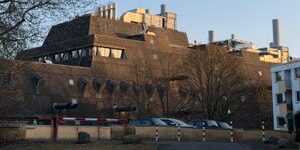
An architectural symbol of its time, the so-called Mäusebunker, or Mouse Bunker, stands in the south district of Berlin. This Brutalist behemoth, officially named the Central Animal Laboratory of the Free University of Berlin, has seen increased attention recently due to online debates over its possible demolition.
Designed by the pioneering architects Gerd and Magdalena Hänska and completed in 1981, the Mäusebunker began as a state-of-the-art animal testing and welfare facility. Its name, taken from a combination of German words – “Mäuse” (mice) and “Bunker” (bunker) – perfectly encapsulates its original function and formidable appearance.
The structure’s Brutalist aesthetic stands in stark contrast to the surrounding neo-classical and modernist architecture, setting it apart in Berlin’s built environment. The building is a testament to the clinical severity and functionality of the Brutalist architectural movement, distinguished for its use of exposed concrete, fortress-like design elements, and a raw, unadorned presentation.
The Mäusebunker has had a contentious history, symbolizing for many both the leaps in science made during the Cold War era and the ethical dilemmas surrounding animal testing. Still, the structure has managed to endure, living past the end of the Cold War in the heart of once-divided Berlin.
Recently, online advocates have given the Mäusebunker a new lease on life by calling for its preservation. This Brutalist icon has now caught the eye of international media, interestingly transformed from a contested object of the past to a digital-age viral phenomenon.
Social media platforms are likely contributing to the surge of interest in the Mäusebunker. User-posted photographs on Instagram, Pinterest, and Twitter capture the Mäusebunker’s intriguing facade — its uncompromising Brutalist form appearing both beautiful and grotesque in its uncompromising starkness.
This fresh wave of attention fueled by online sharing has prompted an impassioned debate about the building’s future. Last year, the Berlin Senate Department for Urban Development and Housing announced plans to demolish the structure. This plan, however, met with notable opposition from preservationists and admirers of Brutalist architecture.
A Change.org petition, “Save the Mäusebunker,” drew worldwide attention after going viral earlier this year. It’s already amassed more than 4,500 signatures from people advocating for the building’s military-grade infrastructure to be leveraged for other uses instead of demolition.
These advocates argue that the building could serve as an emergency shelter, an idea given additional weight in light of global health crisis. Brutalists, a worldwide community of Brutalist architecture enthusiasts, have also proposed transforming it into a museum dedicated to the history and ethos of Brutalism.
However, there are equally profound voices suggesting other alternatives, such as reinvisioning the giant complex into social housing or an urban gardening center.
Undoubtedly, the Mäusebunker’s future remains uncertain, looming as large and undetermined as the building itself. What’s clear, though, is that the former laboratory has found an unexpected second life online — a stark contrast to its controversial past.
Thomas-Bernhard Hilger, a Berlin-based photographer responsible for many images circulating online of the Mäusebunker, succinctly put it: “It’s sad to see a building with such a distinctive facade even considered for demolition. Buildings, especially of this kind, are examples of our architectural history that need to be preserved.”
Regardless of the final decision on the Mäusebunker’s fate, the building has achieved something remarkable: it has rekindled an appetite for Brutalism and brought about a lively debate on architectural preservation within the digital arena. It is a testament to Berlin’s dynamic urban fabric and the power of architecture in shaping cultural discourse.
Original Source: https://www.atlasobscura.com/places/mausebunker