
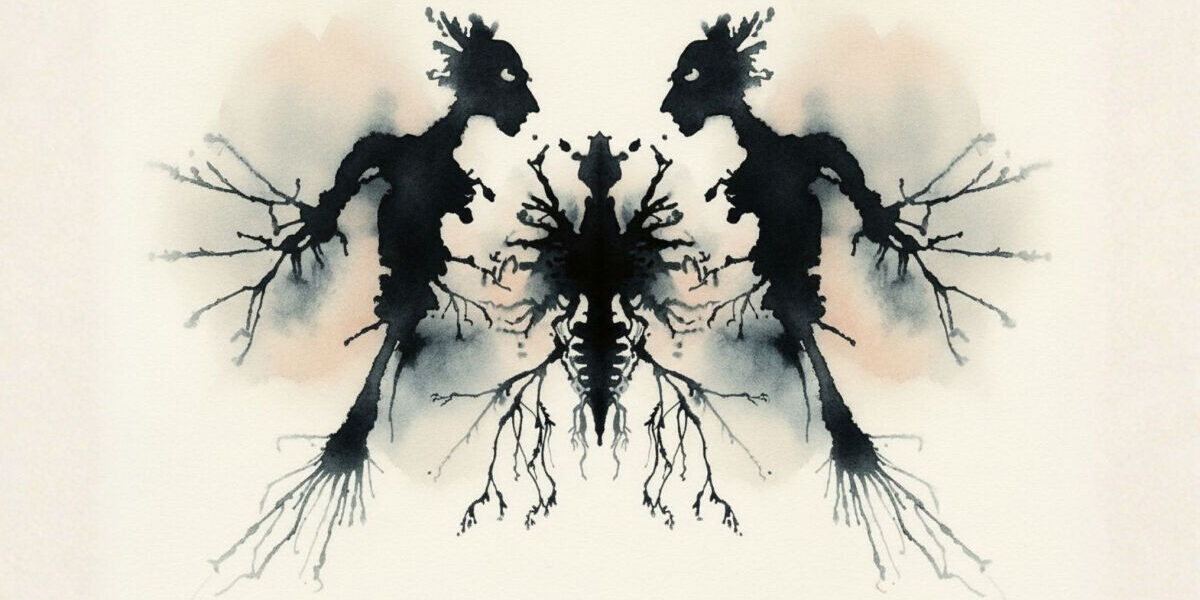
In a digital age where armchair psychoanalysis has become a fond pastime, the internet is turning its fascination toward the mysterious realm of abstract Rorschach inkblots. In a bid to explore public perception and interpretation, 22 new Rorschach-style inkblots have been released for public scrutiny, via an online voting platform.
These 22 unique designs are not your typical black and white inkblots; they’re a welcome twist on the traditional Rorschach inkblots, set to challenge preconceived interpretations. Each blot’s complex patterns and myriad colors, varying from intense reds to cool blues, are designed to engage a wide demographic of individuals, inviting them to peer into the ink spots and vote on what they perceive.
The concept of the Rorschach inkblot test dates back to the early 20th century, a brainchild of Swiss psychiatrist Hermann Rorschach. The original ten blots, used primarily for psychological and psychoanalytical diagnosis, are designed to be interpreted differently by individuals, with each interpretation potentially revealing unique aspects about the viewer’s thought process or emotional state.
This modern twist created a buzz across multiple online platforms, engulfing the online audience with intrigue and prompting discussions on the subjectivity of interpretation. The notion of ‘What do you see first?’ has highlighted contrasting reactions and interpretations based on personal biases, experiences, and perceptions.
Encouraging participants to vote on what they see in the complex artworks is not intended as a form of therapy or clinical evaluation. Rather, it is an interactive societal experiment aiming to shed light on the mysteries of human perception and interpretation.
This voting scheme has resonated with a curious, tech-savvy audience eager to participate in an interactive analysis that moves beyond just viewing a post or liking an update. The open forum for discussion aims to underline the diversity of human cognition and perception, raising contemplative questions about how different individuals can interpret the same stimulus in completely different ways.
Experts have cautioned, however, about attributing too much importance to individual interpretations of the inkblots. “The results from the voting should not be used to make sweeping assumptions about an individual’s psychological state,” communicated Dr. Helen Joseph, a clinical psychologist. “The interpretations are too subjective and can be influenced by an array of factors like mood, surrounding environment, and even recent experiences.”
Nevertheless, the fascination with the inkblots is palpable. The concept of gazing into a simple blot of ink and discerning various images – ranging from the fantastical to the mundane – is a captivating exercise. It is also an enticing opportunity to understand how individual perceptions can diverge significantly.
The decision to invite public voting on these abstract inkblots is an unprecedented step, transforming a once clinical tool into an exciting social exercise. It uses psychology’s intriguing elements as a vehicle for public engagement and discussion, achieving an entertaining, educative, and enlightening experience.
Whether this phenomenon will provide any significant insights or if it is just a passing fixation on psychology’s darker arts, only time will tell. Until then, the world continues to gaze at the 22 abstract Rorschach inkblots, unlocking layers of perception one vote at a time, banding together on a shared yet individual voyage of discovery and intrigue.
Combined with the lens of social media, the voting platform brings together a community of curious minds keen to participate. What the future holds for such mass collaborations of subjective perception remains to be seen. But for now, the abstract Rorschach inkblots remain a focal point in the ever-thriving public sphere, highlighting the subjectivity of human perception and interpretation on a global scale.
Original Source: https://www.boredpanda.com/inkblots-poll-part-3/