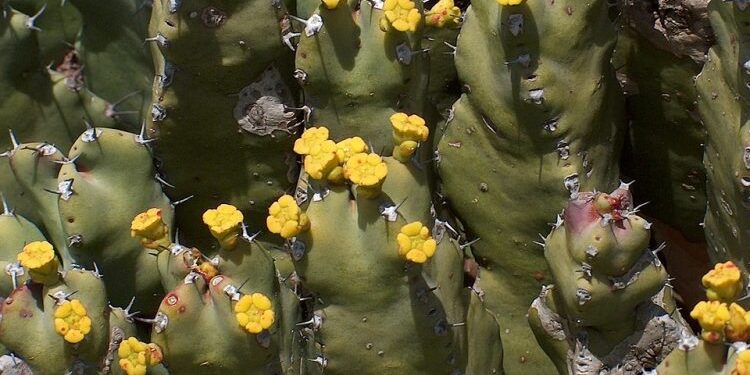
Move over, Carolina Reaper! A new challenger for the world’s spiciest title comes not from the realm of peppers but a different botanical lineage. Recent online news sources highlight a tree known scientifically as the Resiniferatoxin, or Euphorbia resinifera, whose fiery secret far exceeds the burn of the hottest chilli pepper on the global Scoville Heat Scale.
The Scoville Heat Scale, a measure of the hotness or ‘pungency’ of a chilli pepper, gauges the concentration of capsaicin, the chemical responsible for the burning sensation. While the Carolina Reaper, the reigning title-holder, peaks at a sizzling 2.2 million Scoville units, the Moroccan native Euphorbia resinifera, leaves it far behind by clocking in at an unbelievably scorching 16 billion units.
This carnivorous little tree, often mistaken for a cactus due to its appearance, derives its name from “resiniferatoxin” or “RTX”, a compound found in its sap that happens to be the source of its extreme heat. Unlike capsaicin, which triggers a sensation of burning heat via stimulation of nerve cell receptors, RTX acts directly on the proteins to cause a significantly more intense burning sensation.
According to Dr. Michael Caterina, a neuroscientist at Johns Hopkins University, “RTX is about 500 to 1,000 times more potent at stimulating these receptors than capsaicin.” It does so by attaching itself to the sensory receptors mainly responsible for detecting harmful stimuli such as extreme temperature changes, making them overly sensitive and creating an intense perception of pain.
Interestingly, the Euphorbia resinifera, despite the fiery potency of its sap, remains virtually unknown in the realm of culinary use. Unlike the Carolina Reaper, Trinidad Moruga Scorpion, and other super-hot chillies that have carved out a niche among spice aficionados, the Euphorbia resinifera’s superlative heat has largely been untapped in the kitchen due to its potential toxicity.
Its RTX substance, however, has been actively researched for medicinal purposes. Beyond lighting a fire on the taste buds, it has promising implications for pain management. The way it interacts with pain receptors has proven useful in numbing or blocking chronic and acute pain signals. An anaesthetic application directly on the pained area can provide a pain relief effect lasting weeks to months.
However, one must tread carefully. Even a tiny trace of RTX on the skin can cause significant discomfort, and direct exposure to mucous membranes can result in severe reactions. Consequently, thorough safety measures are necessary while studying or using this plant, with controlled extraction and precise dosage to avoid unwanted adverse effects.
While the world’s spiciest pepper has its loyal fanbase who relish its searing heat, the mighty Euphorbia resinifera is in a league of its own. The biochemical weaponry flowing in its veins is not just a human challenge but represents an evolutionary masterpiece of the plant kingdom. It is a testament to nature’s capacity to create the extreme, from the depths of the oceans to the fiery sap of a nondescript Moroccan tree.
In conclusion, the Euphorbia resinifera stands as the unchallenged monarch of fire in the botanical world. In its scorching sap lies not only a potentially dangerous substance but also hope for the future of novel pain management techniques. One can only marvel at this plant’s extraordinary ability to manufacture heat that not just outclasses the world’s spiciest pepper but could potentially change the way we perceive and manage pain.