
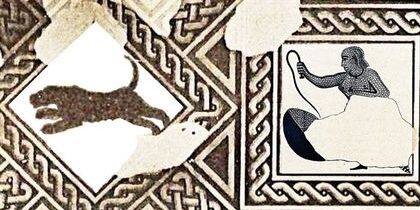
Archaeologists examining an ancient Roman mosaic portraying a woman confronting wild beasts in an arena setting have raised questions about the role of women in Roman gladiatorial games, a commonly male-dominated event. This image, 1,800 years-old, challenges existing narratives about who the gladiators were and their gender.
The amazing piece was unearthed by archaeologists at Villa Casale in the Sicilian town of Piazza Armerina, well-known for its remarkable Roman mosaics, during excavations. An image of a woman in a fighter’s stance poised against wild animals immediately captured global attention.
Depicted on the tile is a woman, bare-chested with a knee-length tunic and a peculiar headgear, holding a whip and a shield while poised against myriad wild beasts. Her style attire was instantly recognizable as attire standard to female gladiators, a category probably overlooked in historical debates. The discovery adds a strong evidence to the presence of female gladiators in ancient Roman culture.
Yet the image raised questions too: is this possibly the first image of a Roman-era woman gladiator? And were women common in the violent contests Roman elites enjoyed so much?
Historians have long acknowledged the existence of female gladiators, known in Latin as “gladiatrix”, but evidence had been based mainly on written documents and rare reliefs. This mosaic picture, however, may be the first of its kind.
“The mosaic presents a tantalizing glimpse into forgotten facets of the gladiatorial games,” said Professor Diane Rayor, a classical languages and literature specialist, who stumbled across the image while preparing a new translation of Suetonius’ “Twelve Caesars”.
Yet the interpretation of this mosaic is not without debate. While some scholars quickly adopted the ‘gladiatrix’ label, others urged caution, stating that it could depict a venatrix, a woman who staged exotica spectacles with animals. Yet given the lack of weaponry typical of a venatrix, such as spears or bows, others stick more to the initial gladiatrix interpretation.
Dr. Alfonso Santori, an archaeologist from the University of Naples, however, argues that uncertainty over the mosaic’s origin and context makes both interpretations plausible. “Until further research can provide new insights, it is fascinating to consider the many roles that women may have played in Roman spectacle,” Santori said.
Male gladiators in Roman times were often slaves, prisoners or criminals, fighting unto death while political elites watched. The discovery of a female gladiatrix would reframe historical understandings of gender roles in ancient Roman society, if she was a willing participant or possibly a captive. It was a known fact that women did not posses the same rights as men did in Roman times.
This noteworthy discovery was shared on the popular archaeology Facebook page ‘Roman Art,’ where it garnered thousands of likes and shares. The page proprietor, Michael Landon, expressed his joy at the uncovering of this unusual artifact. “We are all excited”, he stated, “this might change the way we understand women’s role in ancient Rome.”
Many artifacts as suggestive as this mosaic have been lost to time, leading historians to depend on written records which, arguably can be influenced by their author’s perspective.
This visual evidence offers a new potential narrative about gender roles, societal expectations, and the position of women in the ancient Roman world, while also feeding into the global discourse about the roles and achievements of women in history.
So, while the debate over the identity and the role of the woman in the mosaic rages on, one thing is certain; every new discovery adds new angles to our understanding of women’s roles in the ancient world. Whether warrior or show-woman, this representation of a woman in the center of Roman spectacle continues to stir conversation and provoke thought about unexplored histories of women.